
A Data Governance Challenge the Automotive Industry Cannot Ignore
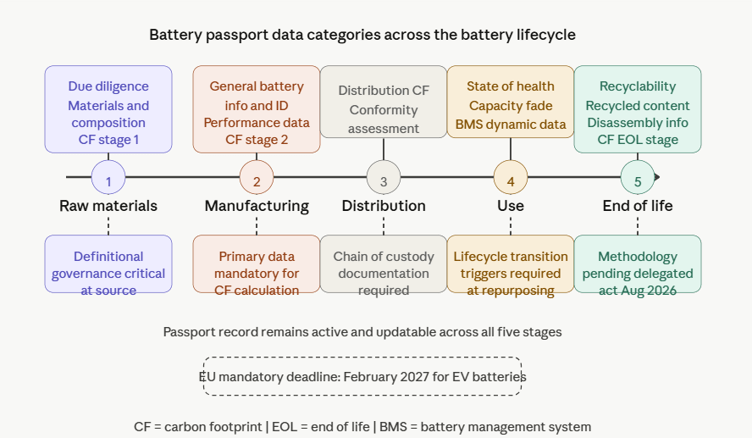
The European automotive industry is approaching a regulatory deadline that will fundamentally change how battery data is managed across the entire value chain. From February 2027, every electric vehicle battery placed on the EU market must be accompanied by a Digital Battery Passport (DBP) – a structured, traceable, and auditable digital record covering the battery’s carbon footprint, material composition, supply chain provenance, performance characteristics, and end-of-life data.
The regulation ‘EU Battery Regulation 2023/1542’ is not a distant compliance exercise. It is an operational reality that every OEM, Tier 1 supplier, and battery manufacturer with European market exposure must begin addressing now.
Why the Battery Passport Is Fundamentally a Data Governance Problem
The Battery Passport is widely discussed as a regulatory requirement and a technology challenge. What is less often recognised is that its most critical dimension is a data quality and data governance problem.
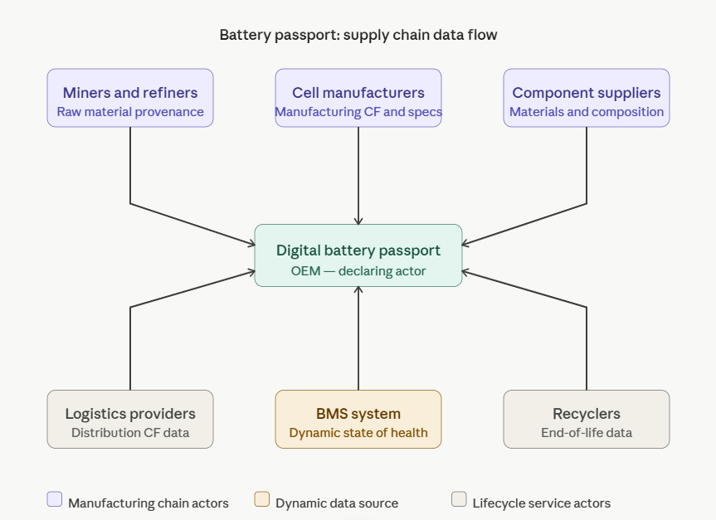
Consider what the regulation actually requires. Battery data must be collected from multiple supply chain actors – miners, refiners, cell manufacturers, logistics providers, and recyclers – each operating in different countries, using different systems, and applying different terminology. That data must be validated for accuracy and completeness before it enters the passport record. Calculations such as carbon footprint figures must be verified against defined methodologies. Every data field must be traceable to its source. The passport must remain accurate and up to date across the battery’s lifetime of ten to fifteen years, through ownership changes, repurposing events, and evolving regulatory requirements.
This is not a technology problem that a platform alone can solve. It is a data pipeline governance problem one that requires defined data quality rules, controlled data inputs, validated transformations, clear actor responsibilities, and robust traceability from source to declared figure. Without these governance foundations in place, even the most sophisticated Battery Passport platform will produce unreliable, non-compliant output. Our analysis of the Battery Passport data model across its major data categories – general battery information, carbon footprint, supply chain due diligence, materials and composition, circularity and resource efficiency, and performance and durability – identified eight recurring governance risk patterns that organisations must address to achieve and maintain compliance:
Governance Risk Patterns
- Definitional ambiguity: Imprecise field definitions produce inconsistent data across supply chain actors, even when each actor believes they are complying correctly.
- Threshold-dependent compliance risk: Errors in upstream measurements produce incorrect compliance determinations that pass format validation but fail substantive accuracy requirements.
- Lifecycle transition governance gaps: Data correct at manufacture becomes incorrect at repurposing or end-of-life transitions without defined update triggers and responsible actor assignments.
- Contributing actor error: Declaring actors carry regulatory liability for data accuracy but depend on contributing actors they do not directly control.Documentation trail deficiencies: Calculations and assessments are unauditable without provenance records covering source, methodology, version, and timestamp.
- Regulatory evolution gaps: Multiple technical requirements remain undefined pending future delegated acts, creating compliance uncertainty that organisations must anticipate rather than react to.
- Supply chain change notification failures: Upstream formulation or process changes invalidate passport data without the declaring actor’s knowledge.
- Assessor subjectivity: Judgment-dependent assessments such as due diligence evaluations produce inconsistent outputs without sufficiently precise frameworks and independent verification mechanisms.
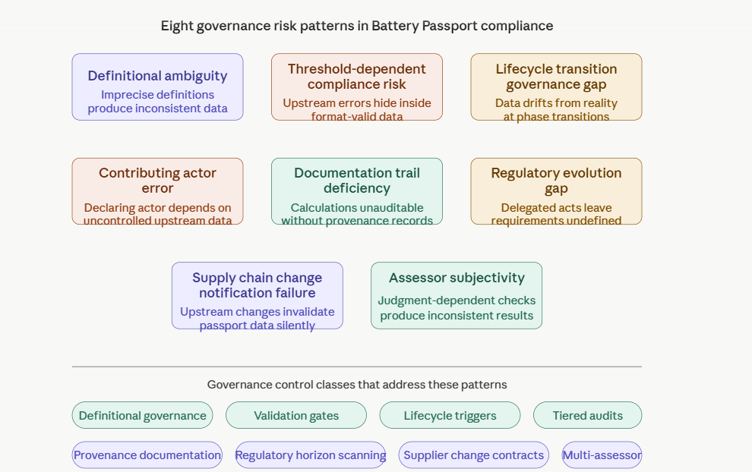
Each of these patterns requires specific governance controls – not just technical validation rules, but organisational processes, contractual requirements, supplier governance frameworks, and regulatory horizon scanning capabilities.
Where requisimus IT Consulting Can Help
At requisimus, we bring a specific and directly relevant capability to this challenge.
Our experience in data quality management and data governance for complex, multi-source engineering data pipelines – where errors carry real downstream consequences – translates directly to the Battery Passport data governance domain.
The governance logic is the same: controlled inputs, validation at boundaries, transformation verification, traceability from source to declared output, and gated handovers to downstream consumers who carry compliance liability.
We offer five specific service areas to help organisations meet their Battery Passport obligations.
1. Battery Passport Readiness Assessment
Before organisations can build a compliant Battery Passport data governance framework, they need to understand where their current processes stand against what the regulation requires. Our readiness assessment provides a structured, category-by-category evaluation of an organisation’s existing data governance processes across all major Battery Passport data categories. We identify specific gaps, assess their regulatory and operational risk, and produce a prioritised action plan for closing them before the February 2027 deadline.
This engagement is designed to be completed rapidly – producing actionable findings within four to eight weeks – and is appropriate for organisations at any stage of Battery Passport preparation, from those just beginning to assess their obligations to those who have started but are uncertain whether their current approach is sufficient.
2. Battery Passport Data Quality Framework Development
Before any supplier data onboarding process can be designed, organisations need a clear, category-level data quality framework that translates the regulatory requirements of EU Battery Regulation 2023/1542 into specific, actionable data quality rules, validation criteria, and governance controls for each data category. Without this foundation, supplier requirements are undefined and validation processes have no standard to enforce against.
We work with organisations to develop this framework, translating each Battery Passport data category into precise data quality requirements: which fields are mandatory, what constitutes a valid value, which calculation methodologies apply, what documentation must accompany each data submission, and which actor is responsible for each data attribute at each lifecycle stage. The result is a structured data quality specification that internal teams, technology partners, and suppliers can work from with clarity.
3. Supplier Data Onboarding Governance
One of the most operationally challenging aspects of Battery Passport compliance is ensuring that upstream supply chain actors provide data in the right format, at the right quality level, and on the right timeline. An OEM or battery manufacturer is only as compliant as the weakest link in their contributing actor chain.
We help organisations assess their current supplier data processes against Battery Passport requirements, identify specific governance gaps, and define the data quality standards, validation requirements, and documentation trail specifications that a compliant supplier onboarding process must meet. Working collaboratively with the organisation’s internal teams and technology partners, we translate our governance knowledge into practical process blueprints- covering data quality requirements per supply chain tier, validation frameworks for incoming supplier data, rejection and resubmission workflows, and documentation trail requirements for demonstrating data provenance to auditors and regulators. This gives organisations a clear, actionable foundation for building or improving their supplier governance infrastructure alongside the partners best placed to implement it.
4. Ongoing Battery Passport Compliance Support
The February 2027 deadline is not an end point. It is the beginning of a continuous compliance obligation. The Battery Passport framework will evolve as delegated acts are finalised, as performance class thresholds are updated, and as the regulation extends to cover additional data requirements. Batteries already in service will need their passport records maintained and updated through repurposing events, ownership changes, and end-of-life transitions.
We provide ongoing governance support to help organisations maintain passport data quality as their battery portfolio grows, as their supply chain evolves, and as the regulatory framework matures. This includes monitoring regulatory developments, updating governance frameworks in response to new delegated acts, and managing the data quality processes that keep passport records accurate and auditable throughout the battery’s operational lifetime.
5. Digital Product Passport Readiness Beyond Batteries
The EU Battery Passport is the first implementation of a broader EU Digital Product Passport framework that will extend to additional product categories – including textiles, electronics, and construction materials – over the coming years. The data governance challenges are structurally identical across all DPP categories: multi-actor supply chains, definitional consistency requirements, lifecycle traceability obligations, and regulatory compliance consequences for data quality failures. Organisations that build robust Battery Passport data governance capabilities now are investing in a foundation that will serve them across the full DPP landscape as it develops. We help organisations design their Battery Passport governance frameworks with this broader DPP extensibility in mind – avoiding point solutions that address only the immediate battery requirement and instead building reusable governance infrastructure applicable across product categories.
Acting Now Rather Than Later
With the February 2027 deadline less than a year away, the window for orderly preparation is closing. Organisations that begin their readiness assessments now have sufficient time to identify gaps, design governance frameworks, onboard suppliers, and test their processes before the deadline. Waiting for long will lead to compressed timelines, higher implementation costs, and greater compliance risk.
The Battery Passport is a data governance challenge that the automotive industry cannot afford to treat as a technology procurement exercise. The platforms and technical infrastructure are necessary but not sufficient. What makes compliance real and sustainable is the data quality discipline and governance rigour that ensures the data flowing through those platforms is accurate, traceable, and fit for regulatory purpose.
That discipline is what we bring to our clients – and it is what will determine who is genuinely compliant in February 2027 and who is merely technically equipped.
For Any Queries Reach Out:
Mrunmayi Parchure
Mail: Mrunmayi.Parchure@requisimus.com