
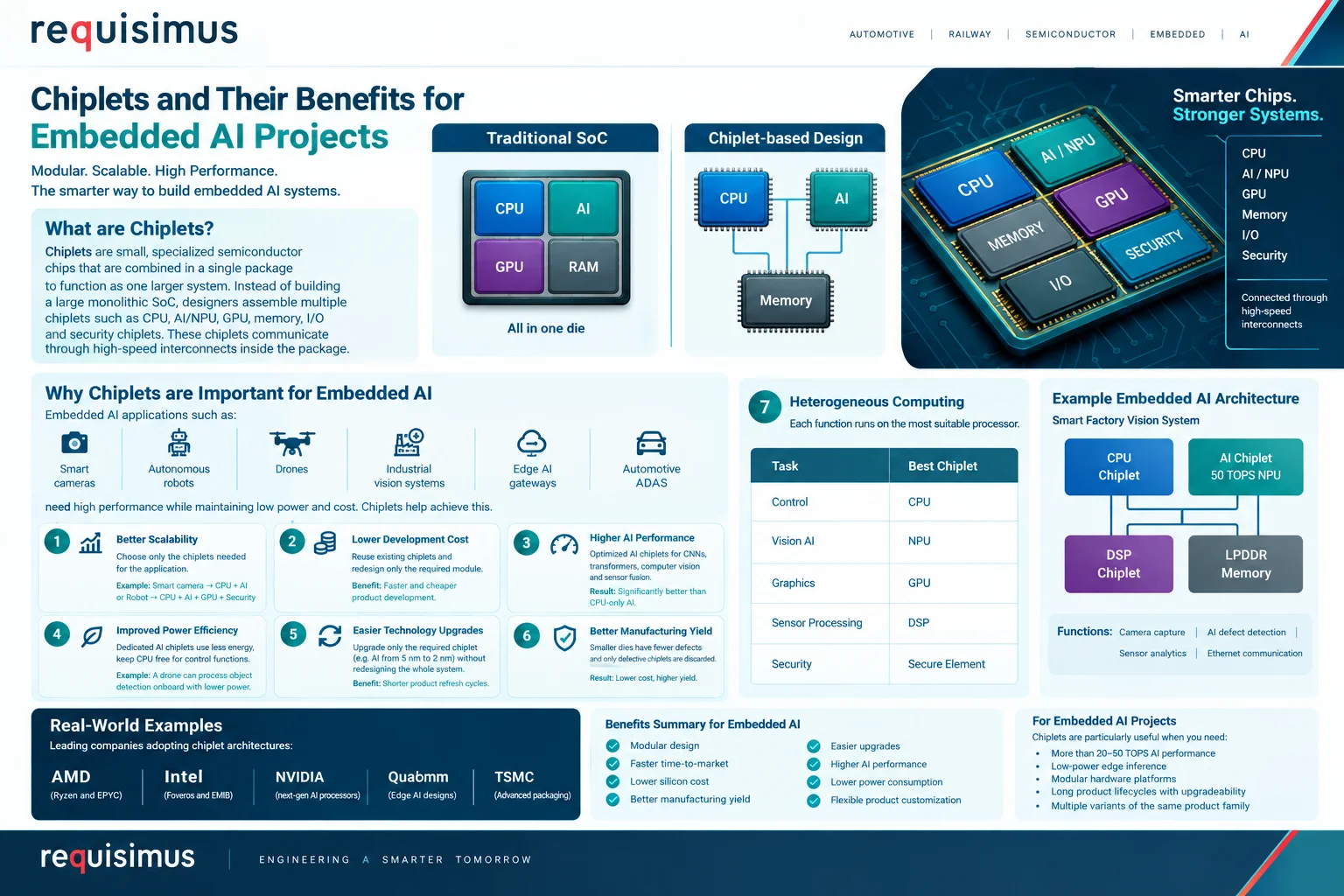
What are Chiplets?
Chiplets are small, specialized semiconductor chips that are combined in a single package to function as one larger system. Instead of building a large monolithic System-on-Chip (SoC), designers assemble multiple chiplets such as:
- CPU chiplet
- AI/Neural Processing Unit (NPU) chiplet
- GPU chiplet
- Memory chiplet
- I/O chiplet
- Security chiplet
These chiplets communicate through high-speed interconnects inside the package.
Traditional SoC
+-----------------------+
| CPU | AI | GPU | RAM |
| All in one die        |
+-----------------------+
Chiplet-based Design
+------+  +------+
| CPU  |--| AI   |
+------+  +------+
    \      /
     \    /
   +--------+
   | Memory |
   +--------+
Why Chiplets are Important for Embedded AI
Embedded AI applications such as:
- Smart cameras
- Autonomous robots
- Drones
- Industrial vision systems
- Edge AI gateways
- Automotive ADAS
need high performance while maintaining low power and cost. Chiplets help achieve this.
1. Better Scalability: You can choose only the chiplets needed for the application.
Example: Smart camera → CPU + AI accelerator or Robot → CPU + AI + GPU + Security
This modular approach reduces development effort.
2. Lower Development Cost: Designing a large AI SoC can cost hundreds of millions of dollars.
With chiplets: Reuse existing CPU chiplets, Reuse AI accelerator chiplets, Reuse I/O chiplets Only the required module needs redesign.
Benefit: Faster and cheaper product development.
3. Higher AI Performance: Dedicated AI chiplets can be optimized specifically for:
- CNN inference
- Transformer models
- Computer vision
- Sensor fusion
This provides significantly better performance than running AI only on a CPU.
4. Improved Power Efficiency: Embedded devices are often battery-powered.
A dedicated AI chiplet: Performs AI tasks with lower energy, Keeps CPU free for control functions, Reduces overall power consumption
Example: A drone can process object detection onboard while consuming less power.
5. Easier Technology Upgrades
Suppose: CPU chiplet uses 5 nm technology, AI chiplet moves to 2 nm technology. You can upgrade only the AI chiplet without redesigning the entire system.This shortens product refresh cycles.
6. Better Manufacturing Yield: Large monolithic chips have lower manufacturing yield because a defect can ruin the whole die.
With chiplets: Smaller dies have fewer defects & Only defective chiplets are discarded
Result: Lower cost, Higher production yield
7. Heterogeneous Computing: Embedded AI workloads contain:
- Control tasks, Signal processing, Machine learning inference,Graphics processing
Chiplets allow each function to run on the most suitable processor.
| Task | Best Chiplet |
| Control | CPU |
| Vision AI | NPU |
| Graphics | GPU |
| Sensor Processing | DSP |
| Security | Secure Element |
Example Embedded AI Architecture: For a smart factory vision system:
+-------------+
| CPU Chiplet |
+-------------+
+-------------+
| AI Chiplet  |
| 50 TOPS NPU |
+-------------+
+-------------+
| DSP Chiplet |
+-------------+
+-------------+
| LPDDR Memory|
+-------------+
Functions: Camera image capture, AI defect detection, Sensor analytics, Ethernet communication all inside one package.
Real-World Examples
Companies actively adopting chiplet architectures include:
- AMD (Ryzen and EPYC processors)
- Intel (Foveros and EMIB packaging)
- NVIDIA (next-generation AI processors)
- Qualcomm (future edge AI designs)
- TSMC (advanced chiplet packaging technologies)
Benefits Summary for Embedded AI
✅ Modular design
✅ Faster time-to-market
✅ Lower silicon cost
✅ Better manufacturing yield
✅ Easier upgrades
✅ Higher AI performance
✅ Lower power consumption
✅ Flexible product customization
For Embedded AI Projects
Chiplets are particularly useful when you need:
- More than 20–50 TOPS AI performance
- Low-power edge inference
- Modular hardware platforms
- Long product lifecycles with upgradeability
- Multiple variants of the same product family
For future edge AI devices (robots, industrial automation, autonomous systems, smart cameras), chiplet-based architectures are expected to become a major design approach because they balance performance, power, cost, and flexibility much better than traditional monolithic SoCs.
For more information contact:
Name: Gnana Swamy
Email: gnana.swamy@requisimus.com