
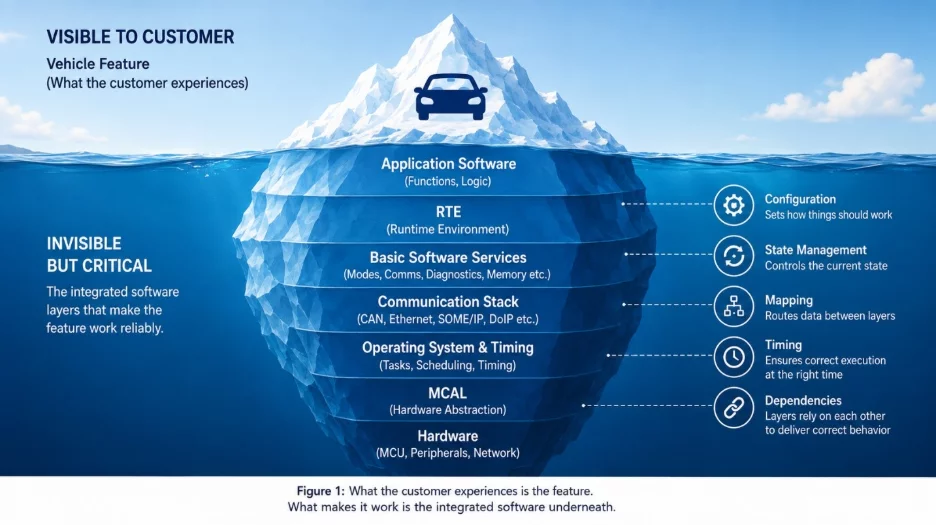
Modern vehicles contain millions of lines of software distributed across dozens of Electronic Control Units (ECUs). As the industry moves toward electrification, connectivity, autonomous functions, and software-defined vehicles, software complexity continues to grow at an unprecedented pace.
Much of the industry’s attention is focused on new features, advanced algorithms, connectivity platforms, and user experiences. However, many of the most critical challenges in ECU development originate elsewhere.
Not in the feature itself – but in the integration of the software that enables it.
When Everything Looks Correct—But the System Still Fails
A common assumption in software development is that if each component functions correctly in isolation, the complete system should also function correctly.
Automotive software rarely behaves this way. A feature may be implemented correctly. A communication interface may be configured correctly.
A diagnostic service may pass individual testing. Yet when the complete ECU is integrated and validated, unexpected behavior emerges. Messages arrive late. Functions become unavailable.
Diagnostic responses behave unexpectedly.
Timing requirements are missed.
System states transition incorrectly.
Validation results become inconsistent.
The challenge is not that individual components are defective.
The challenge is that modern ECUs are systems of interconnected software layers whose behavior emerges from interaction rather than isolation.
The Complexity Nobody Sees
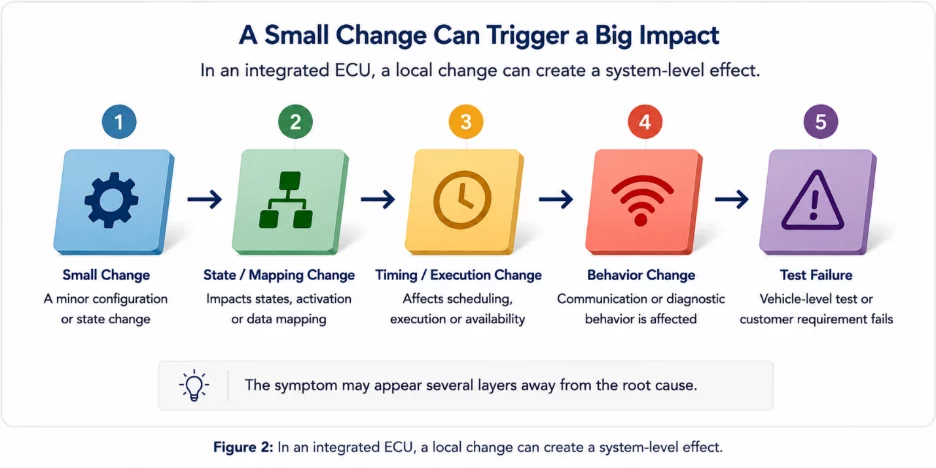
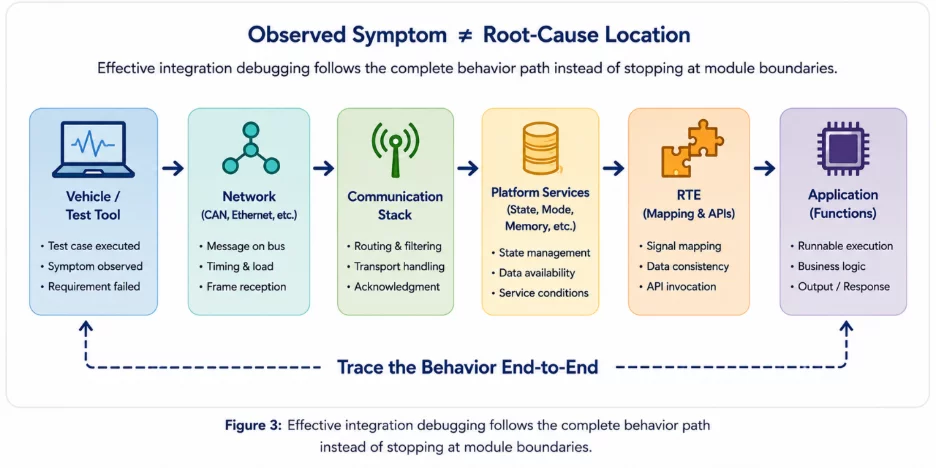
Most software issues are expected to originate where the symptom appears. In embedded automotive systems, that assumption is often incorrect. The visible symptom and the actual root cause may exist in entirely different parts of the software stack.
A communication issue may originate from timing behavior.
A timing issue may originate from a state transition. A state transition issue may originate from an integration dependency.
A diagnostic issue may originate from data availability. The software behaves exactly as configured.
The problem is that multiple configurations interact in ways that were never anticipated. This is where integration becomes both difficult and essential.
The Cost of Integration Challenges
When integration issues are discovered late in the development cycle, the impact extends far beyond engineering effort.
Validation activities become longer.
Root-cause analysis becomes more complex.
Ownership discussions increase.
Software releases become less predictable.
Project timelines come under pressure.
Most importantly, valuable engineering time is spent locating issues rather than solving them.
In large automotive programs, the investigation effort often costs significantly more than the eventual software correction. The defect itself is rarely the largest expense. The delay caused by finding it is.
Why Traditional Debugging Is No Longer Enough
As vehicle architectures become increasingly sophisticated, debugging individual software components is no longer sufficient.
Engineers must understand how behavior propagates across the entire system.
A change made in one area may influence functionality somewhere completely different.
A seemingly minor configuration update can affect communication behavior, diagnostic availability, execution timing, feature activation, or system responsiveness.
The ability to understand these interactions has become one of the most valuable skills in modern embedded software development.
Successful teams no longer view software as a collection of separate modules.
They view it as a connected ecosystem.
Integration as a Competitive Advantage
The automotive industry has invested heavily in improving software quality, functional safety, cybersecurity, and development efficiency.
Yet many program risks continue to emerge during integration and validation.
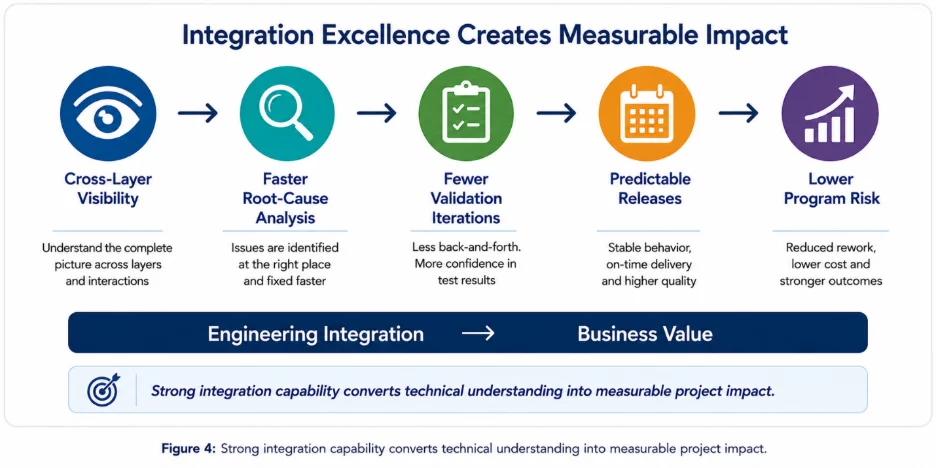
Organizations that develop strong integration capabilities gain a significant advantage.
Issues are identified earlier.
Root causes are isolated faster.
Validation becomes more predictable.
Software releases become more stable.
Engineering teams spend more time developing innovation and less time chasing unexpected interactions.
The result is not only better software quality, but also faster delivery and lower development risk.
Looking Ahead
The future of automotive software will be defined by increasingly connected and intelligent systems.
Electrification, software-defined vehicles, centralized computing platforms, and advanced mobility solutions will continue to increase software complexity.
But regardless of how vehicle architectures evolve, one principle remains unchanged:
Vehicles do not operate as individual software components.
They operate as integrated systems.
Understanding those interactions—and managing them effectively—will remain one of the defining factors behind successful ECU programs.
Conclusion
Software features create value.
Software integration enables that value to reach the vehicle.
As automotive systems become more complex, the ability to understand and manage interactions between software layers becomes increasingly important.
Because in modern ECU development, success is not determined solely by how well individual components work.
It is determined by how well they work together.
Want to Explore AUTOSAR Integration Further?
Have questions about AUTOSAR integration, ECU software development, system integration, or validation?
Our team would be happy to connect and discuss your requirements.
Whether you are facing integration issues, communication or timing challenges, diagnostic complexities, or system-level validation concerns, feel free to get in touch with us.
Let’s discuss your ECU integration challenges →
👤 Sai Sunder Gudipati
📧 Saisunder.Gudipati@requisimus.com
Thank you for reading..!
requisimus | India