
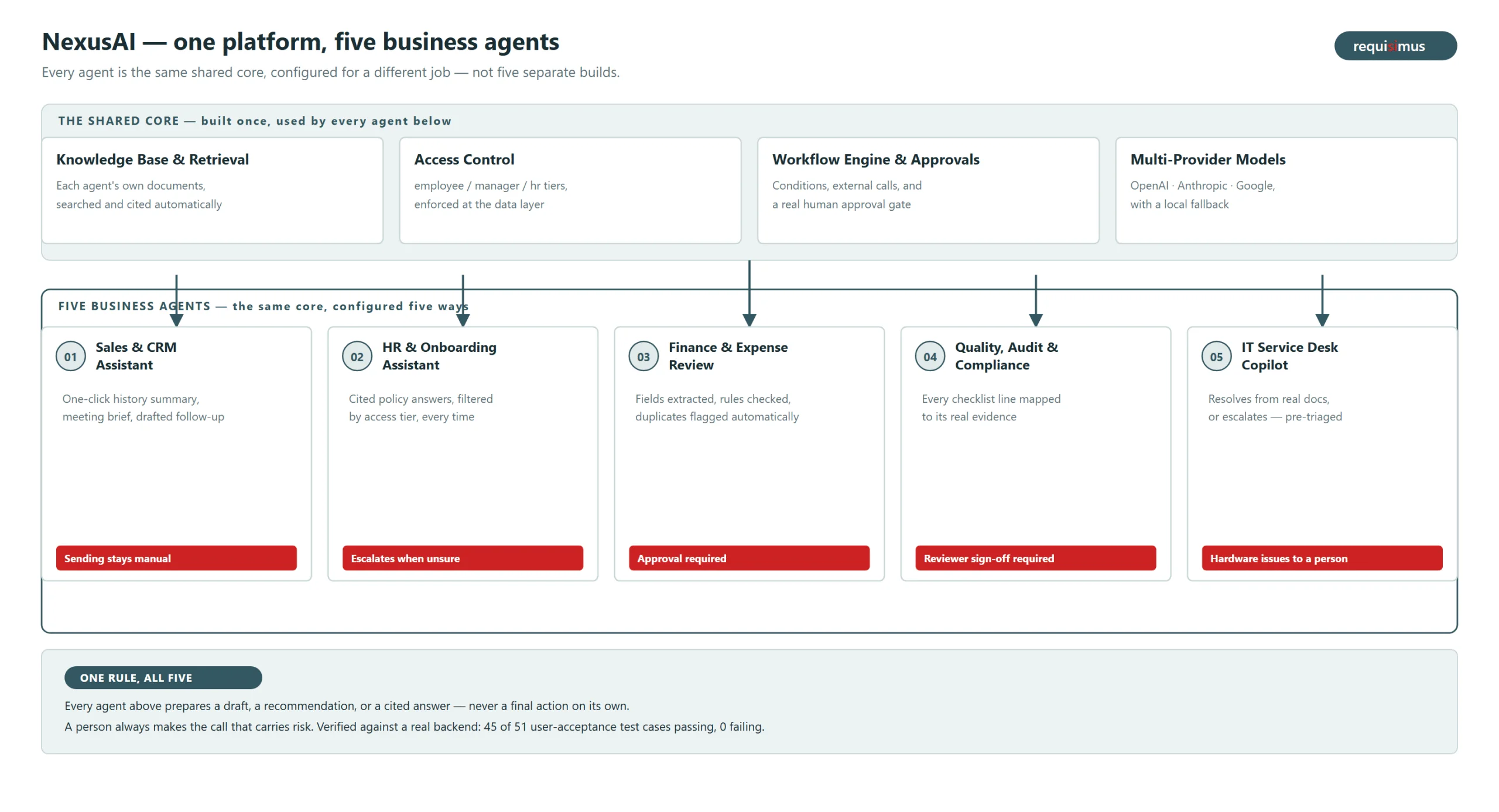
The Problem Every Department Shares
Every department carries the same hidden cost: capable people spending hours on work that isn’t hard, just repetitive. A sales rep re-reads six months of notes before a renewal call. HR answers the same policy question for the fortieth time. A finance reviewer checks an invoice against a dozen rules by hand. An auditor hunts through procedures for the one paragraph that proves a control was followed. An IT inbox fills with tickets that are really the same three issues, worded differently each time.
That cost rarely shows up on a budget line, because it’s spread thin across every team rather than concentrated anywhere obvious — which is exactly why it goes unaddressed longer than it should.
The Solution, At a Glance
NexusAI follows the same shape every time, across every department it touches: it reads your own documents and rules, prepares the answer or the draft, and a person still makes the call that carries risk. Nothing here replaces judgment — it removes the delay and the manual legwork standing in front of it.
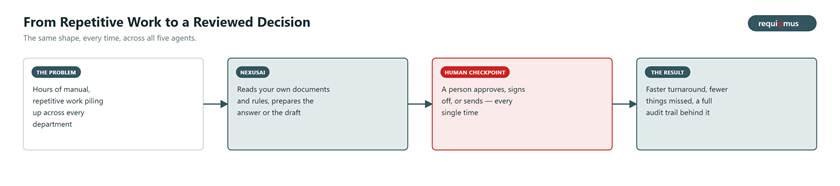
One Platform, Five Agents
It isn’t five separate products — it’s one platform, configured five different ways for five different jobs: Sales & CRM, HR & Onboarding, Finance & Expense Review, Quality/Audit & Compliance, and IT Service Desk. Each shares the same knowledge retrieval, the same access control, and the same approval workflow — which is also why a sixth use case tomorrow starts from the same foundation instead of from zero.
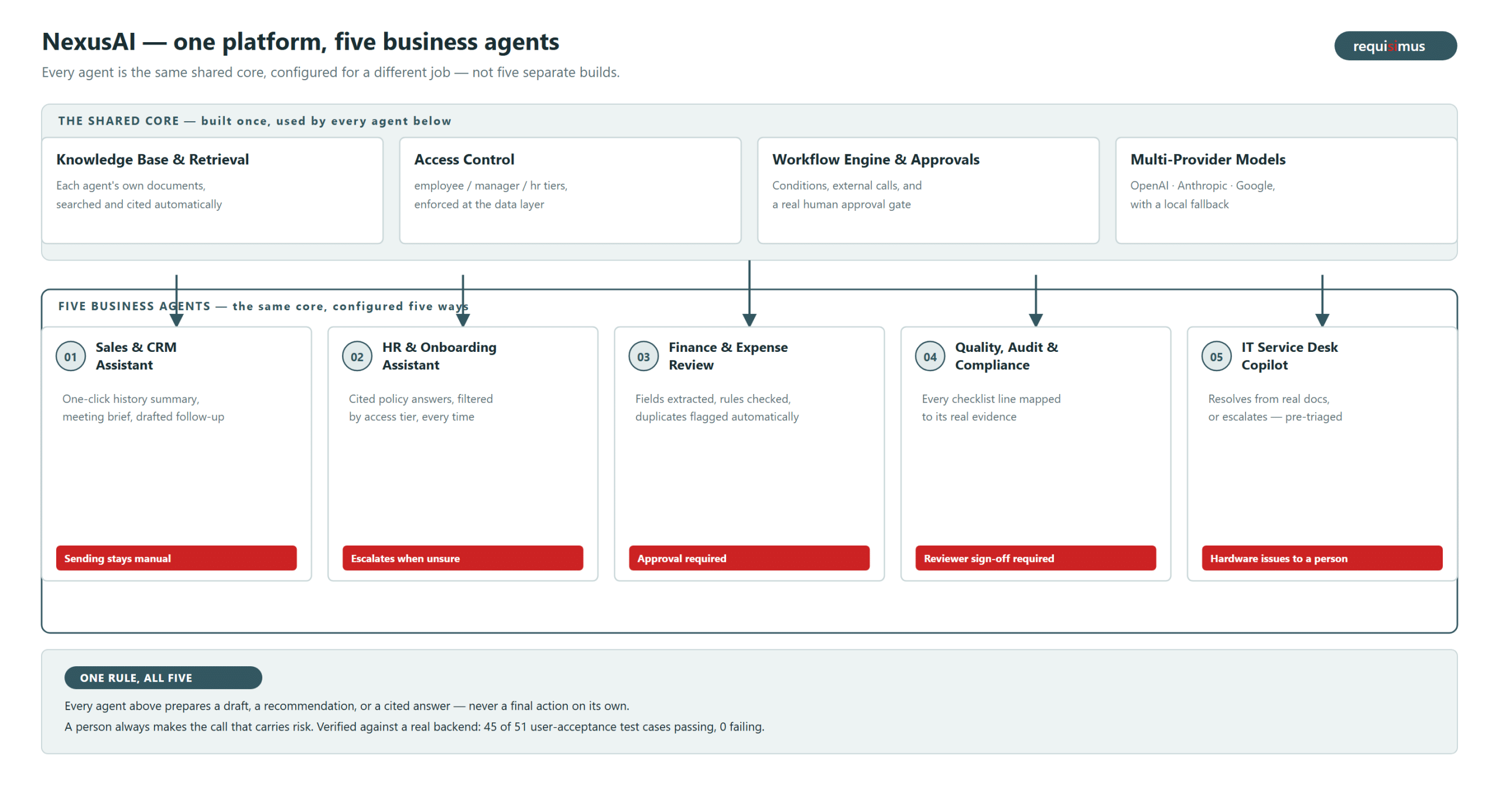
Five Agents, Five Business Wins
What each agent actually changes for the team that uses it — the problem it removes, how it removes it, and what that’s worth.
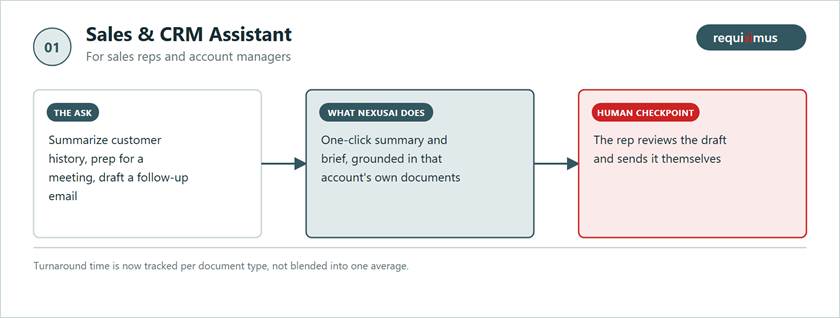
Sales & CRM Assistant
The problem: Reps spend real time re-reading months of call notes and emails before every renewal call, then draft follow-ups from scratch.
The NexusAI fix: One click produces an account summary, a meeting brief, and a drafted follow-up email — grounded in that account’s own history.
What it’s worth to you: Less prep time per call, turnaround leadership can actually see broken out by type, and zero new tools for a rep to learn.
HR & Onboarding Assistant
The problem: Policy answers vary depending on who’s asked, and sensitive HR documents are protected only by people remembering not to overshare.
The NexusAI fix: Every answer is instant and cited, filtered to exactly what that person’s access tier allows — and escalates to HR the moment the agent isn’t confident.
What it’s worth to you: Consistent policy answers company-wide, sensitive data protected by design rather than good intentions, and HR pulled in only for what genuinely needs a person.
Finance & Expense Review Assistant
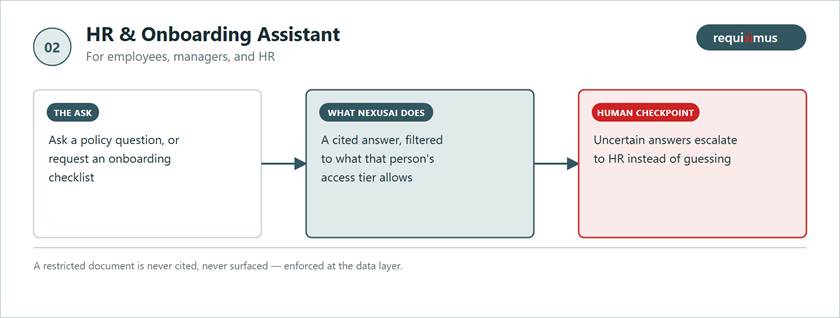
The problem: Every invoice is checked by hand against a dozen rules, and a reformatted duplicate submission can slip straight past that check.
The NexusAI fix: Fields are extracted and checked automatically against your own configured rules, with duplicate detection that catches a reworded resubmission — every finding lands as a draft.
What it’s worth to you: Problems are caught before they reach a reviewer’s queue, exception rates become a real number instead of a guess, and nothing posts to accounting without a person’s sign-off.
Quality, Audit & Compliance Assistant
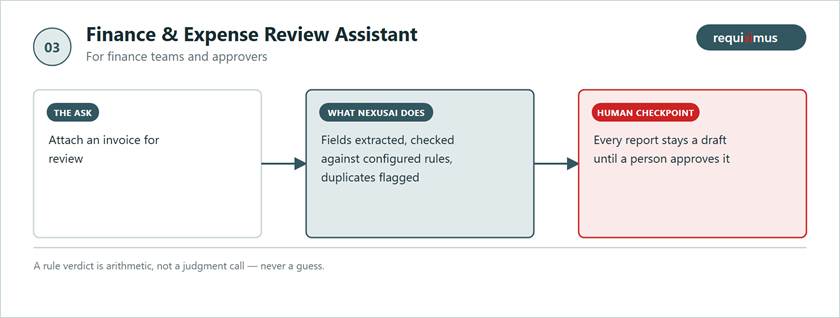
The problem: Auditors manually search procedures to find the one paragraph that proves a single checklist line was actually followed.
The NexusAI fix: Every requirement is mapped to its evidence automatically and judged conservatively — Supported, Partial, or Unsupported — with the source excerpt attached.
What it’s worth to you: Audit preparation time drops sharply, and a “supported” verdict is never the tool guessing — sign-off always still needs an authorized reviewer.
IT Service Desk Copilot
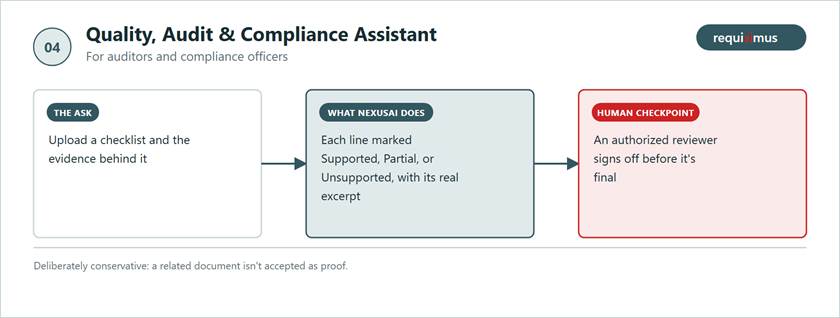
The problem: Simple, well-documented issues still go through a ticket form and a wait, even when the fix is already written down somewhere.
The NexusAI fix: Plain-language issues are resolved instantly when it’s safe to do so, or escalated pre-classified by category and severity — with duplicate tickets suppressed automatically.
What it’s worth to you: The majority of tickets, in a well-documented environment, never need a person at all — and the ones that do arrive already triaged, not as a raw complaint.
Built to Work With What You Already Use
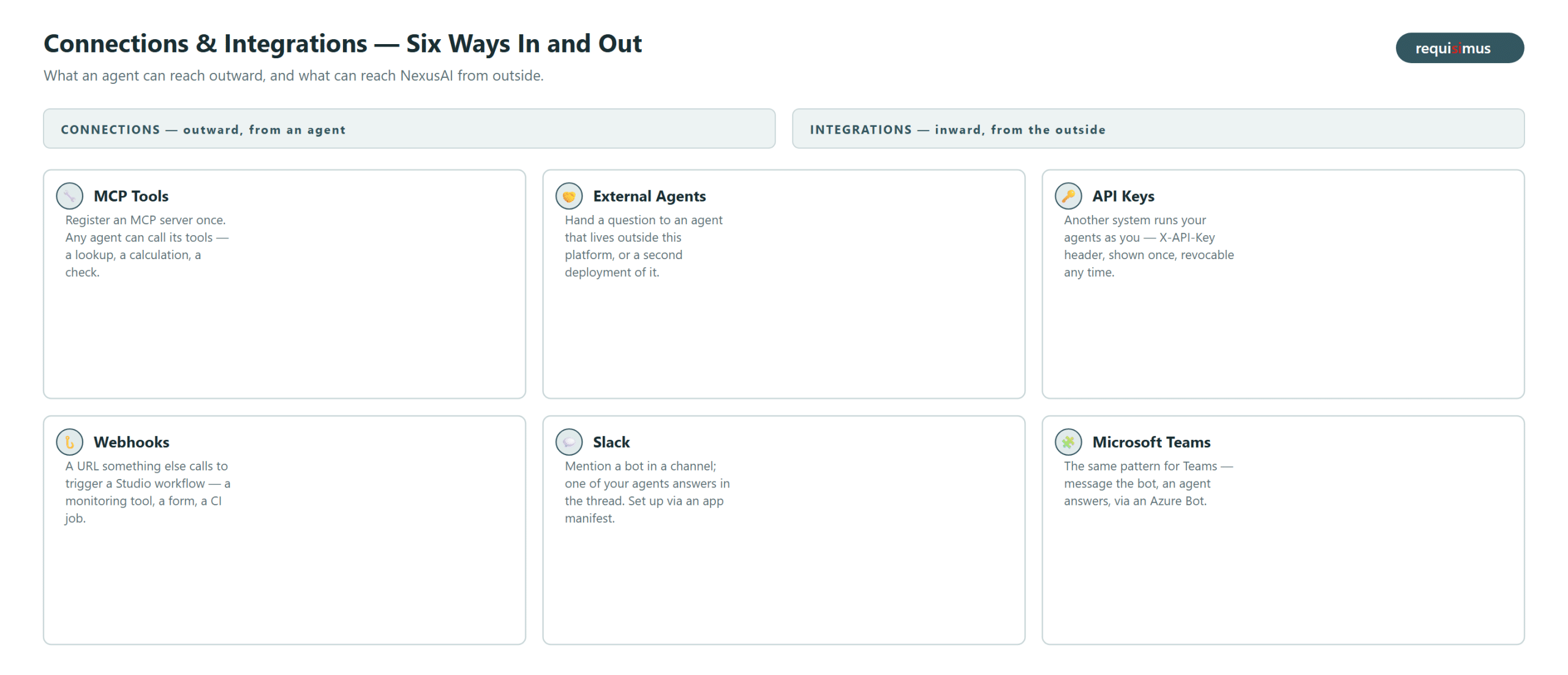
An agent that can only read documents and talk is useful; one that can also act on a live system, or be reached from the tools your team already has open, is more useful still. Every agent can reach outward to take a real action — a lookup, a calculation, a status check — and the platform itself can be reached through an API key, a webhook, or a Slack/Microsoft Teams bot. Nobody has to open a new application to get an answer.
Proof, Not Promises
A 51-case testing pass across all five agents and the platform underneath them — plus a dedicated security review — currently stands at 45 passing, 0 failing, 2 partial, and 4 awaiting a live walkthrough. That process caught and fixed real issues before they could reach a customer, including a duplicate-ticket detector that missed a reworded resubmission and an invoice extraction that could leak data across documents. One proposed fix to the Audit assistant was tried, found to make it more confidently wrong, and deliberately reverted rather than shipped — a tool whose entire job is flagging uncertainty doesn’t get to ship a change that makes it more confident and wrong.
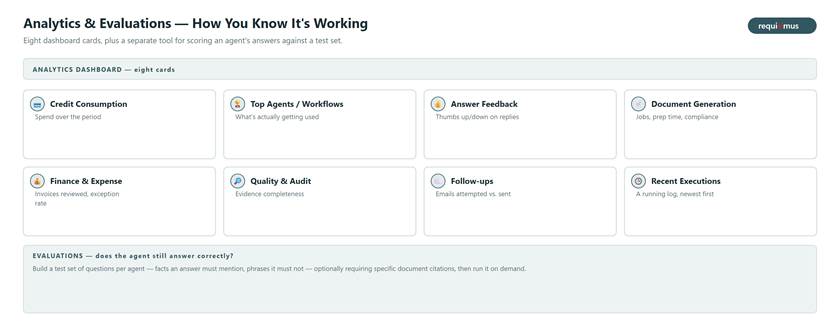
An Analytics dashboard keeps that proof ongoing rather than a one-time claim: spend, usage, feedback, and every use case’s own metrics, with a separate Evaluations tool that checks an agent still answers correctly after a document or a prompt changes.
The Business Case
The direct case is time: less manual research before a sales call, less back-and-forth chasing invoice exceptions, less time assembling audit evidence from scratch, faster resolution on IT issues that don’t need a person at all.
The less obvious case is risk — and it may matter more. Fewer things slip through: a duplicate invoice paid twice, an outdated policy presented as current, a conclusion stated with more confidence than the evidence supports. Access control is enforced at the data layer, not hidden behind a UI toggle, and every answer carries its source and its audit trail.
To be direct about where this stands: these are capabilities verified through structured testing against a real, working backend — not yet metrics from months of live production use. The case rests on the mechanisms described and the testing behind them.
Before vs. After, At a Glance
| Use case | The cost of doing it by hand | What changes with NexusAI |
| Sales & CRM | Hours re-reading history before every call; follow-ups written from scratch | One-click summary, brief, and follow-up — a number leadership can track |
| HR & Onboarding | Inconsistent answers; sensitive files protected only by people asking the right way | Cited answers, filtered by access tier, escalated the moment the agent is unsure |
| Finance & Expense | Manual checks against a dozen rules; reworded duplicates slip through | Automatic checks and duplicate detection; every finding still needs a person’s approval |
| Quality & Audit | Days spent hunting procedures for one line of evidence | Every requirement pre-mapped to evidence, with full traceability back to source |
| IT Service Desk | A ticket and a wait, even for issues with a documented fix | Resolved instantly when safe, or escalated pre-classified with duplicates suppressed |
No step here removes a person from the decision that matters — it removes the delay and the manual legwork in front of that decision.
Best Practices for Getting the Most Out of NexusAI
- Start with your highest-volume repetitive task, not the most complex one. A fast, visible win builds the case for the harder rollout — it doesn’t need to be the hardest problem first.
- Let departments share infrastructure instead of rebuilding it. The access-tier system built for HR already secures Finance and Audit too — a sixth use case reuses what exists rather than starting from zero.
- Keep the human checkpoint where the real risk is, and nowhere else. Requiring approval on every single step slows adoption without adding any real safety — reserve it for the decision that actually carries weight.
- Watch the Analytics dashboard from day one. “Faster” and “safer” should be numbers your team can point to, not just an impression — measure before you expand.
- Roll out one agent, prove it, then extend. The same workflow builder is general-purpose — a second or sixth use case starts from everything the first one already proved.
What’s Next
If your team is spending real hours on work that looks like any of the five above, we’d like to show you what this looks like running against your own documents.
Security and edge-case testing continues as an ongoing discipline, not a one-time pass — and these five use cases are a starting point, not a ceiling. The same visual workflow builder they run on means your team can wire its own agents, approvals, and external connections into a sixth use case, or a hundredth, without waiting on anyone to build it for them.
For more information contact
Name: Soundarya Mahadev
Email: Soundarya.mahadev@requismius.com