
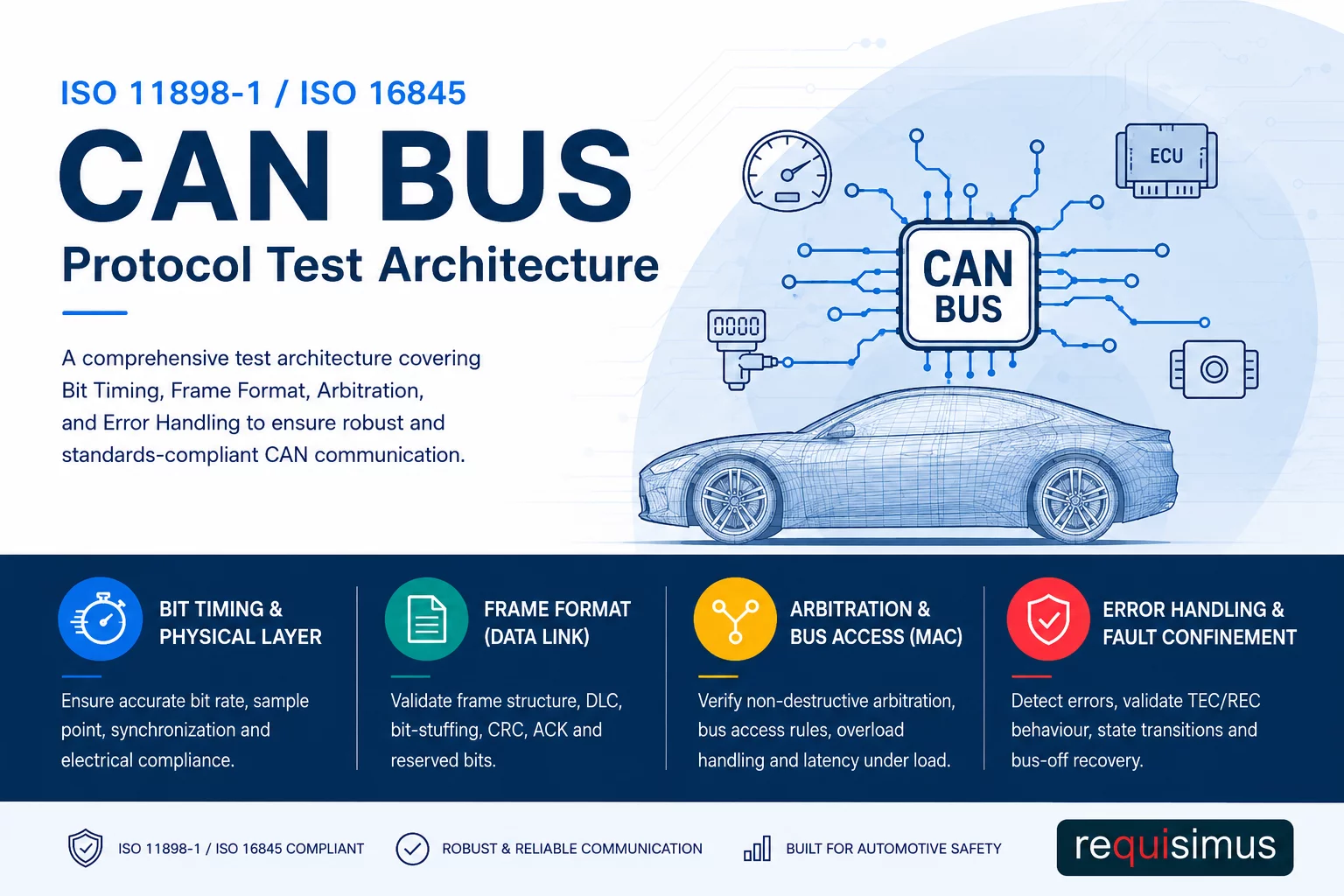
Test Cases & Use Cases | ISO 11898-1 / ISO 16845
CAN Conformance Test Coverage Overview
- 4 conformance domains — Physical, Frame Format, Arbitration, Error Handling
- 32 test cases mapped to ISO 11898-1 / ISO 16845-1/2
- 16 supporting use cases
| Domain / Sub-Area | Layer | Standard Ref. | Status |
| Bit Timing & Physical Layer | Physical | ISO 11898-1 §11 / -2 | Ready |
| Frame Format (Data Link) | Data Link | ISO 11898-1 §8 / ISO 16845-1 | Ready |
| Arbitration & Bus Access | Data Link (MAC) | ISO 11898-1 §8.3 | Ready |
| Error Handling & Fault Confinement | Data Link | ISO 11898-1 §8.4-5 / ISO 16845-2 | Ready |
Bit Timing & Physical Layer Conformance
Standard: ISO 11898-1 §11 / ISO 11898-2 | Layer: Physical | Method: Bench / Oscilloscope | Priority: HIGH
| TC-ID | Test Case | Expected Result / Pass Criteria |
| BT-01 | Nominal bit rate accuracy | Measured bit rate = configured rate (e.g. 500 kbps) ±0.1% on every node |
| BT-02 | Sample point position | Sample point matches the network’s cluster configuration within tolerance |
| BT-03 | Synchronization Jump Width (SJW) | Bit sync holds under worst-case oscillator drift within the SJW budget |
| BT-04 | Hard sync on bus-idle entry | Node resyncs on the first recessive→dominant edge after idle |
| BT-05 | Resynchronization on mid-frame edges | Phase error corrected within configured SJW, no bit loss |
| BT-06 | CAN_H / CAN_L voltage levels | Dominant/recessive levels meet ISO 11898-2 thresholds under load |
| BT-07 | Propagation delay budget | End-to-end delay (transceiver+bus+connectors) stays within budget |
| BT-08 | Oscillator tolerance worst-case (Tx fast/Rx slow) | No bit errors at worst-case combined tolerance |
Use Case Options
Choose one option to implement — each is a self-contained deliverable
Option 1: ECU Bench Bring-Up Validation
- Verify a new ECU transceiver meets ISO 11898-2 timing before network entry
- Measure bit rate, sample point and SJW against the cluster spec
- Deliverable: bit-timing conformance report signed off before HIL
Option 2: Multi-Supplier Interoperability Check
- Validate that supplier ECUs share an identical bit-timing configuration
- Detect oscillator-tolerance mismatches that cause intermittent bus errors
- Deliverable: cross-supplier timing compatibility matrix
Option 3: Worst-Case Bus-Load Timing Analysis
- Stress the bus at maximum load with the tightest oscillator tolerances
- Confirm no bit errors occur at the edge of the timing budget
- Deliverable: timing margin report for network release sign-off
Option 4: EMC Pre-Compliance Support
- Correlate bit-timing conformance with EMC susceptibility results
- Isolate whether signal violations stem from timing or bus wiring
- Deliverable: pre-compliance data package for the EMC lab
Frame Format Conformance (Data Link Layer)
Standard: ISO 11898-1 §8 / ISO 16845-1 | Layer: Data Link | Method: CAN Analyzer | Priority: HIGH
| TC-ID | Test Case | Expected Result / Pass Criteria |
| FF-01 | Standard frame format (11-bit ID) | All fields conform to the ISO 11898-1 standard-frame layout |
| FF-02 | Extended frame format (29-bit ID) | IDE bit and 29-bit identifier fields conform to spec |
| FF-03 | Data Length Code (DLC 0–8) | Received DLC matches the transmitted payload length exactly |
| FF-04 | Bit-stuffing rule | A stuff bit is inserted after every 5 consecutive identical bits |
| FF-05 | CRC field (15-bit) | Calculated CRC matches the transmitted CRC at every receiver |
| FF-06 | CRC delim. / ACK slot / ACK delim. / EOF | All frame-closing fields conform to ISO 11898-1 |
| FF-07 | Remote frame (RTR) request | RTR request yields the expected data-frame response |
| FF-08 | Reserved bits (r0/r1) | Transmitted dominant; frame accepted if received recessive |
Use Case Options
Choose one option to implement — each is a self-contained deliverable
Option 1: New Node Bus Compliance Test
- Run the ISO 16845-1 frame-format suite against a new ECU
- Confirm standard and extended frames are formed to specification
- Deliverable: pass/fail conformance report per test-case ID
Option 2: Gateway Frame-Translation Validation
- Verify a gateway correctly re-frames signals between CAN segments
- Check DLC, CRC and stuffing are preserved across the translation
- Deliverable: gateway conformance evidence for integration sign-off
Option 3: DBC / ARXML Definition Cross-Check
- Compare on-bus frame format against the DBC/ARXML network database
- Catch mismatched DLC, byte order or identifier type before SOP
- Deliverable: database-vs-bus discrepancy list
Option 4: Toolchain Interoperability Check
- Confirm CANoe/CANalyzer and the custom stack decode frames identically
- Detect tool-specific misinterpretation of stuffing or CRC
- Deliverable: cross-tool decode comparison log
Arbitration & Bus Access Conformance
Standard: ISO 11898-1 §8.3 | Layer: Data Link (MAC) | Method: Multi-Node Rig | Priority: MEDIUM
| TC-ID | Test Case | Expected Result / Pass Criteria |
| AB-01 | Priority arbitration (lower ID wins) | Lower-ID node transmits uninterrupted; higher-ID node backs off |
| AB-02 | Arbitration-loss handling | Losing node switches to receive without corrupting the winning frame |
| AB-03 | Non-destructive bitwise arbitration | No data corruption under simultaneous multi-node transmission |
| AB-04 | Inter-frame space / bus-idle detection | Correct IFS timing observed between consecutive frames |
| AB-05 | Overload-frame generation/detection | Overload frame generated and recognized when triggered |
| AB-06 | Error Passive suspend-transmission | Node suspends transmission for 8 bit-times after Error Passive |
| AB-07 | Worst-case simultaneous transmission stress | Arbitration resolves correctly at maximum bus load |
| AB-08 | Safety-message latency under load | High-priority message meets its latency budget under worst-case load |
Use Case Options
Choose one option to implement — each is a self-contained deliverable
Option 1: Multi-ECU Network Stress Test
- Trigger simultaneous transmission from all nodes at worst-case load
- Confirm arbitration resolves correctly with no data corruption
- Deliverable: stress-test log with zero arbitration failures
Option 2: Safety Message Priority Guarantee
- Verify a safety-relevant message (e.g. brake/airbag) always wins arbitration
- Measure worst-case latency against the safety budget
- Deliverable: latency-vs-budget evidence for the safety case
Option 3: Bus-Load / Latency Analysis
- Model and measure network response time under maximum realistic load
- Identify margin before latency requirements are violated
- Deliverable: bus-load analysis report for network release
Option 4: Gateway Congestion Behaviour Test
- Verify a gateway buffers/prioritizes correctly when both segments saturate
- Confirm no frame loss or mis-ordering occurs under congestion
- Deliverable: gateway congestion test report
Error Handling & Fault Confinement Conformance
Standard: ISO 11898-1 §8.4-8.5 / ISO 16845-2 | Layer: Data Link | Method: Fault Injection Rig | Priority: HIGH
| TC-ID | Test Case | Expected Result / Pass Criteria |
| EH-01 | Bit-error detection | Detected when a transmitted bit ≠ monitored bus level |
| EH-02 | Stuff-error detection | Detected on an illegal 6th consecutive identical bit |
| EH-03 | CRC-error detection | Detected when received CRC ≠ calculated CRC |
| EH-04 | Form-error detection | Detected on a fixed-format field carrying an illegal value |
| EH-05 | ACK-error detection | Detected when no receiver acknowledges the frame |
| EH-06 | TEC/REC counter behaviour | Counters increment/decrement per ISO 11898-1 fault-confinement rules |
| EH-07 | Error Active → Error Passive transition | Triggers correctly at REC/TEC ≥ 128 |
| EH-08 | Error Passive → Bus-Off → Recovery | Bus-Off at TEC ≥ 256; recovers after 128×11 recessive bits |
Use Case Options
Choose one option to implement — each is a self-contained deliverable
Option 1: Fault-Injection Robustness Test
- Inject bit/stuff/CRC/form/ACK errors and confirm correct detection
- Verify error frames are transmitted and correctly interpreted network-wide
- Deliverable: fault-injection matrix with detection latency per error type
Option 2: Single-Node Isolation Test
- Force one node into a persistent fault (e.g. shorted transceiver)
- Confirm the faulty node reaches Bus-Off without disturbing the network
- Deliverable: network-resilience evidence for the ISO 26262 safety case
Option 3: Error-State Machine Regression
- Walk the node through Error Active → Passive → Bus-Off → Recovery
- Confirm counters and transitions match ISO 11898-1 thresholds exactly
- Deliverable: state-machine conformance report per ISO 16845-2
Option 4: Wiring-Fault Resilience Test
- Apply open-circuit, short-to-ground and short-to-battery on CAN_H/CAN_L
- Confirm the network degrades gracefully and recovers once cleared
- Deliverable: wiring-fault test report for harness validation sign-off
Why CAN Conformance Testing Matters
- Interoperability — Multi-supplier ECUs on the same bus behave predictably — no silent timing or framing mismatches.
- Standards Compliance — ISO 11898-1 / ISO 16845-1/2 evidence gives OEMs auditable proof the network meets spec.
- Fault-Tolerance Assurance — Error-active / passive / bus-off transitions are proven correct before HIL or vehicle test.
- Network Robustness — Worst-case arbitration and bus-load behaviour is validated ahead of full integration.
- Safety Case Support — Traceable pass/fail evidence feeds directly into ISO 26262 and ASPICE SWE.6 work products.
- Early Defect Detection — Transceiver, driver and framing bugs surface on the bench — not in vehicle-level testing.