
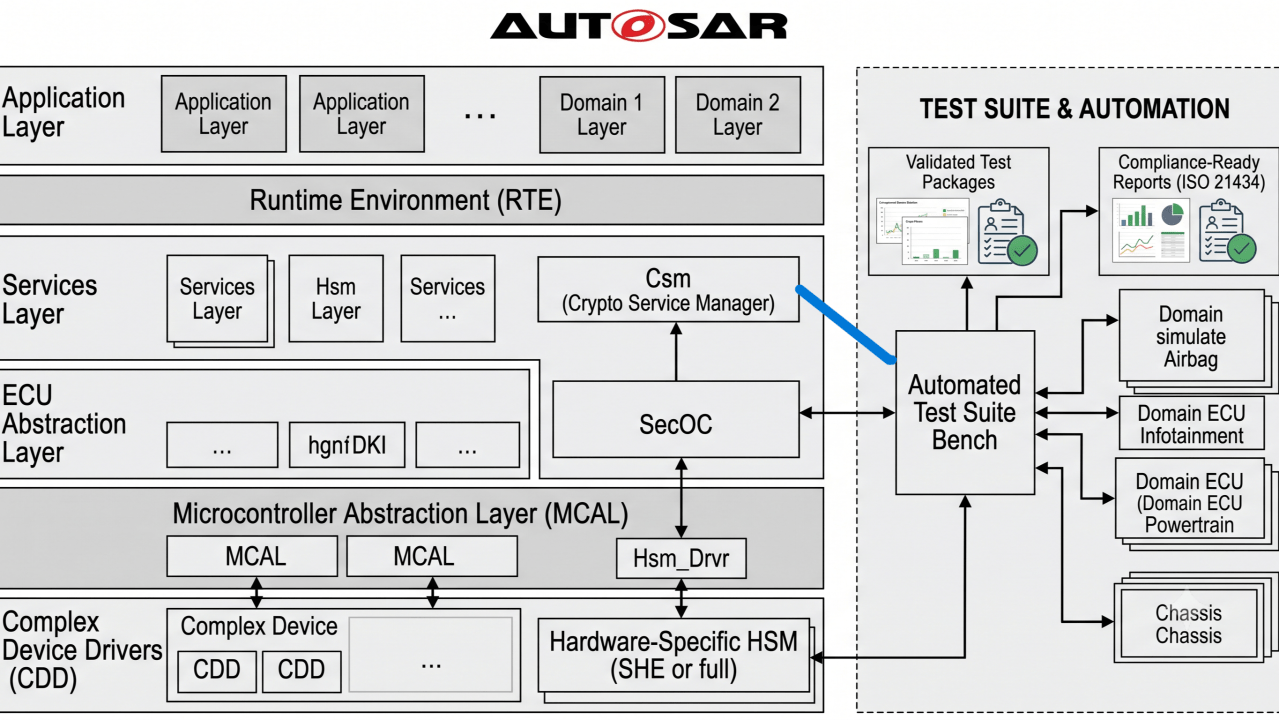
Hardware Security Modules (HSMs) are the bedrock of modern automotive cybersecurity. From securing CAN/Ethernet communications to enabling encrypted FOTA updates, HSMs protect the electronic brain of the vehicle.
However, across automotive OEMs and Tier-1s, a recurring challenge emerges during integration: Treating the HSM firmware as a generic black box across every ECU.
An Airbag Control Module (ACM), a Central Gateway/Infotainment Head Unit, and a Power Inverter/BMS serve drastically different functions, run on different OS architectures, and operate under different timing constraints.
Attempting to apply a standard, static HSM test script across these diverse environments leaves critical security vulnerabilities undiscovered—and delays SOP timelines.
The Multi-ECU Dilemma: One HSM, Four Radically Different Contexts
When integrating SHE (Secure Hardware Extension) or full-spec HSM firmware (such as Evita Light, Medium, or Full), test suites must validate cryptographic functionality within the domain-specific constraints of each ECU:
1. Airbag & Safety-Critical ECUs (Fast Boot & Low Latency)
- The Constraint: Safety systems require sub-100ms boot times and near-instantaneous response.
- The Test Target: Verifying that cryptographic signature checks (Secure Boot) and key derivation do not cause boot latency or violate strict deterministic timing windows.
2. Infotainment & Connected Gateways (High Exposure & Complex Protocols)
- The Constraint: Exposed to external attack vectors via Cellular, Wi-Fi, and Bluetooth.
- The Test Target: Testing advanced cryptographic operations (TLS/IPsec acceleration, asymmetric key generation) and validating side-channel attack resilience under high bus traffic.
3. Powertrain & BMS (High-Frequency Real-Time Loops)
- The Constraint: Microcontrollers handle continuous high-speed control loops (e.g., motor control, cell balancing).
- The Test Target: Ensuring that background HSM operations (like SecOC key rotation or diagnostic session authentication) do not cause task starvation or interrupt latency in the main CPU core.
4. Braking & Chassis Controllers (Functional Safety meets Cybersecurity)
- The Constraint: Strict alignment between ISO 26262 (ASIL-D) and ISO 21434.
- The Test Target: Validating safe state fallbacks when the HSM detects a cryptographic failure or memory corruption attempt without locking up critical actuator communications.
Moving Beyond Code Coverage: Automated HSM Integration Test Suites
To eliminate the manual overhead and execution risk of multi-ECU HSM integration, our team has architected a Domain-Specific HSM Firmware Integration Test Suite.
Rather than simply verifying if an AES-128 API returns the correct ciphertext, our validation framework tests the complete cyber-physical behavioral stack:
- SecOC & Freshness Management: Simulating out-of-order, stale, and replay CAN messages across Powertrain and Body networks to verify HSM-driven MAC verification under stress.
- Secure Storage & Lifecycle Management: Automated verification of key isolation, debug interface disabling (JTAG lock), and state transitions (Production vs. Service mode).
- Fault Injection & Negative Testing: Automated glitching and bus manipulation during HSM API execution to ensure the host microcontroller handles security faults gracefully without bricking.
- Regulatory Compliance Mapping: Mapping test coverage directly to UN R155 and ISO 21434 audit requirements, producing compliance-ready evidence reports.
Bridge the Security Gap Before SOP
Integrating HSM firmware across heterogeneous vehicle architectures shouldn’t require months of manual script tweaking and custom bench setups.
By utilizing an automated, multi-ECU test framework, engineering teams can reduce HSM integration testing cycles by over 60% while ensuring every domain controller—from Safety to Telematics—is hardened against real-world attack vectors.
Looking to streamline your HSM validation process?
Whether you are deploying Classic AUTOSAR, Adaptive platforms, or custom RTOS stacks, our team provides fixed-scope HSM Firmware Integration & Validation Work Packages.
Send a message or reach out via email given below to discuss how we can accelerate your ISO 21434 compliance and HSM rollout.
Email: Mahesh.Hegde@requisimus.com