
Objective
To deliver comprehensive System Testing and Hardware-in-the-Loop (HIL) validation services that ensure the functionality, reliability, and performance of automotive Electronic Control Units (ECUs) before production release. The primary goal is to help OEMs and Tier-1 suppliers achieve zero-defect software delivery by combining rigorous test strategy design with automated execution frameworks aligned with ASPICE and ISO 26262 requirements.
Key Metrics
The effectiveness of our System Testing and Hardware-in-the-Loop (HIL) validation services is reflected through measurable outcomes across automotive software development programs. Our testing approach improves validation efficiency, strengthens compliance with industry standards, and supports reliable ECU software delivery
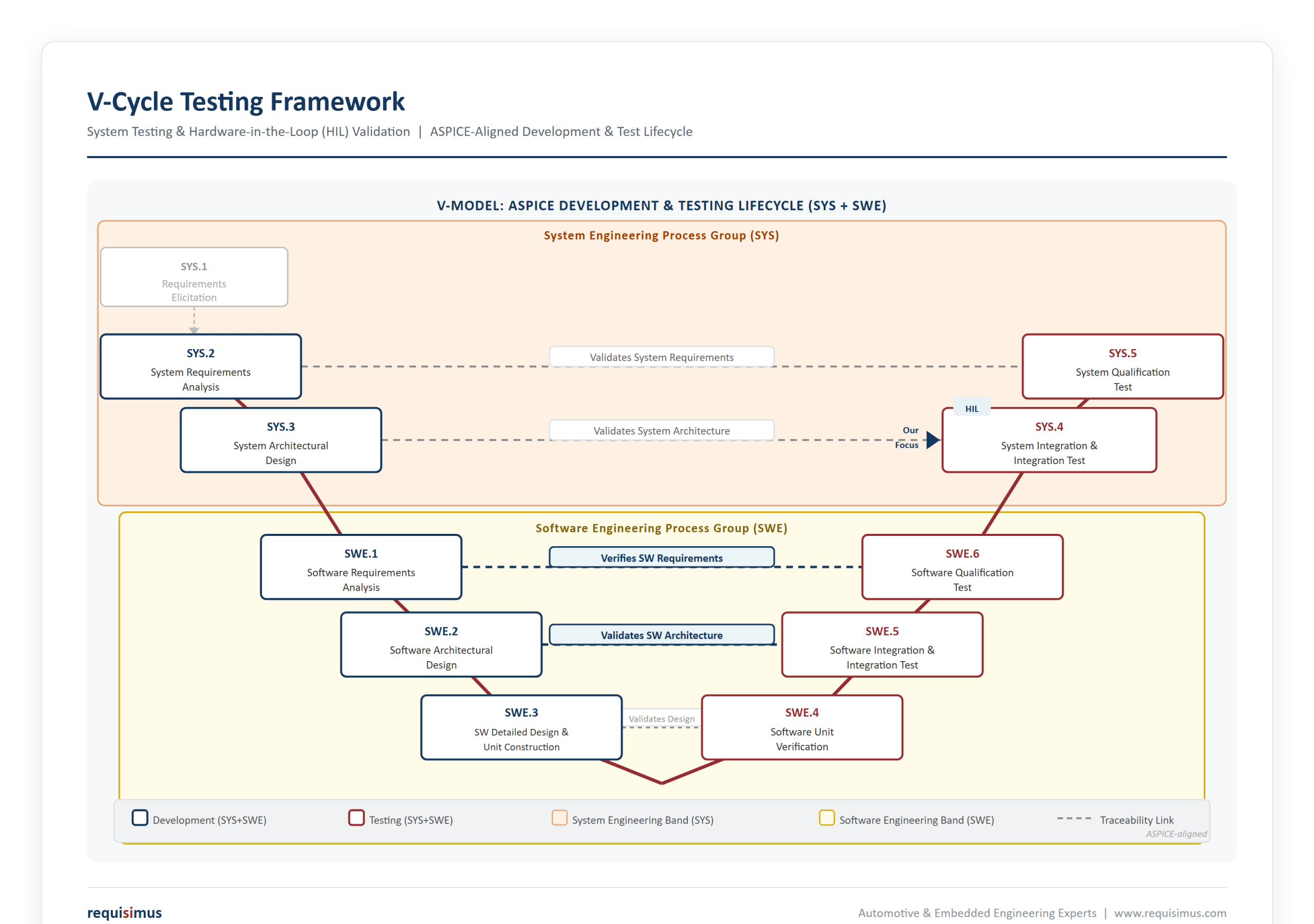
Referring to the above architecture Diagram: V-Cycle Testing Framework
Our testing services map directly to the V-model lifecycle, ensuring every development artefact has a corresponding validation activity with full traceability from requirements to acceptance.
Solution & Approach
Requirement Analysis & Configuration
– Analyzed system and functional requirements from OEM specifications and derived test scenarios accordingly.
– Prepared test specifications, traceability matrices, and test data configurations in compliance with
project standards.
– Configured HIL benches using dSPACE and third-party hardware for ECU-level validation.
- Network Management and Development
– Implemented automated test sequences for ECU communication over CAN, LIN, FlexRay, and Ethernet networks.
– Validated network diagnostics, signal timing, and fault handling under real-time conditions.
– Ensured synchronization between multiple ECUs during gateway and power management tests. - Memory and Bootloader Integration
– Performed bootloader validation including flashing, rollback, and recovery procedures.
– Tested memory management functionalities such as EEPROM writes, retention, and data recovery
after power cycles.
– System Testing and HIL Testing Services
– Verified OTA update stability through HIL simulation under controlled fault conditions. - Security Enhancement
– Conducted cybersecurity validation for ECUs with cryptographic modules.
– Simulated attack scenarios to test secure diagnostics, authentication, and encrypted communication.
– Ensured adherence to ISO 21434 and OEM cybersecurity compliance frameworks. - Testing and Validation
– Executed functional, regression, performance, and stress testing using automated frameworks.
– Utilized Python and CAPL scripts for test automation and reporting.
– Integrated Continuous Testing with CI/CD pipelines for iterative software verification
Impact
Our structured System Testing and Hardware-in-the-Loop (HIL) validation approach delivers measurable improvements across the automotive software development lifecycle.
- Improved Test Coverage
- Improved test coverage and traceability across all ECU functional areas, providing end-to-end visibility from requirements to test results.
- 60% Manual Effort Reduction
- Reduced manual test effort by 60% through automation and reusable HIL frameworks, significantly shortening validation cycle times.
- Enhanced Software Stability
- Enhanced software stability and performance, minimizing post-deployment issues and reducing field defect rates.
- OEM Certification Readiness
- Supported multiple OEM programmes achieving ASPICE and ISO 26262 certification readiness with comprehensive test documentation.
Technology Stack
The solution leverages industry-standard automotive validation tools and technologies.
| Category | Technologies |
| Test Execution | CAPL, Python, MATLAB / Simulink |
| HIL Infrastructure | dSPACE HIL Benches |
| Automotive Networks | CAN, FlexRay, Ethernet (DoIP) |
| Functional Safety | ISO 26262, ISO 21434 |
| Cybersecurity | ISO 21434 |
| Requirements & ALM | IBM DOORS, PTC Integrity |
| CI/CD Integration | Jenkins |
Ready to Accelerate Your ECU Validation Programme?
From HIL bench setup to full regression automation, Requisimus delivers comprehensive System Testing and Hardware-in-the-Loop (HIL) validation services that scale with the complexity of your automotive programs. Whether you are working toward ASPICE and ISO 26262 compliance or looking to reduce time-to-release without compromising software quality, our experienced engineering team provides reliable,
standards-compliant testing solutions tailored to your development needs.
Get in Touch
Email: basavaraj.tarihalli@requisimus.com
Website: www.requisimus.com