
Introduction
Modern software systems rarely live in a single repository. In real-world environments—especially in domains like embedded systems or safety-critical platforms—code is distributed across multiple repositories such as base software (BSW), core logic, customer integrations, and testing frameworks.
To address this complexity, I designed and implemented an AI-driven CI/CD pipeline for a C++/ C project that not only automates build and testing but also integrates multiple input repositories into a unified workflow.
This article walks through the architecture, implementation, challenges, and key learnings from building this system.
Why Multi-Repository CI/CD?
Traditional CI/CD pipelines assume a single codebase. However, in complex systems:
- Core logic lives in one repo
- Base software (BSW) is maintained separately
- Customer-specific code exists in another repo
- Test frameworks evolve independently
The challenge:
How do you ensure everything works together—automatically—on every change?
System Architecture Overview
The pipeline is designed to handle multiple repositories as inputs and process them through an AI-powered testing system.
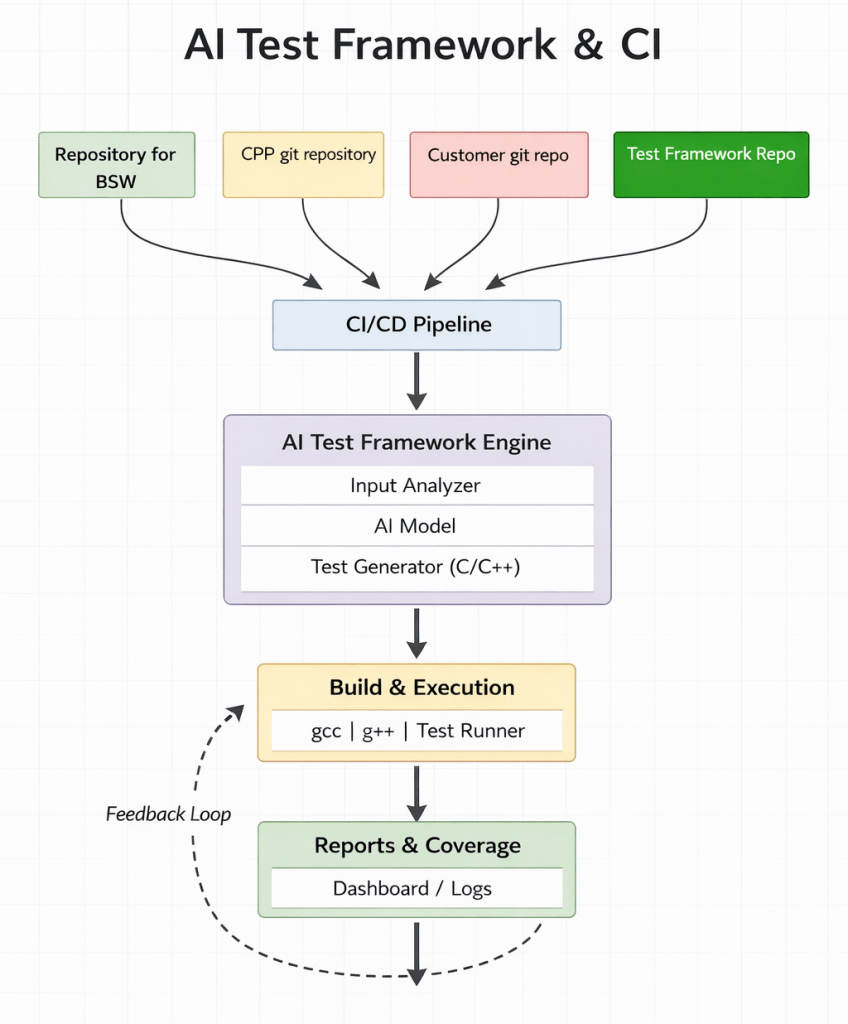
High-Level Flow
Multiple Repositories → CI/CD Pipeline → AI Test Engine → Build & Execution → Reports & Coverage → Feedback Loop
Input Repositories
- AUTOSAR/BSW Repository
- Core C++ Repository
- Customer Repository
- Test Framework Repository
Each of these contributes to the final build and validation process.
AI Test Framework Engine
At the heart of the pipeline is the AI Test Framework Engine, which consists of:
1. Input Analyzer
- Understands code structure across repositories
- Identifies functions, dependencies, and interfaces
2. AI Model
- Generates meaningful test scenarios
- Adapts based on code patterns and changes
3. Test Generator (C/C++)
- Produces executable unit tests
- Integrates directly with the build system
CI/CD Pipeline Workflow
Step 1: Trigger
- Pipeline triggers on:
- Push events
- Pull Requests
Step 2: Multi-Repo Checkout
- All required repositories are fetched
- Correct versions/branches are aligned
Step 3: Build Configuration
cmake -B build -DCMAKE_BUILD_TYPE=Release
Step 4: AI Test Generation
python python_framework/test_generator.py –source-dir <multi-repo-source>
Step 5: Build & Execute
cmake –build build
ctest –test-dir build
Step 6: Code Coverage
- Integrated using coverage tools (e.g., gcov/lcov)
- Provides visibility into tested vs untested code
Step 7: Export Results
ctest –test-dir build –output-junit build/test-results.xml
Step 8: Report Generation
python python_framework/report_publisher.py –xml build/test-results.xml –html reports/report.html –json reports/summary.json
Reporting & Feedback Loop
The pipeline generates:
- HTML dashboard (visual insights)
- JSON summary (automation-friendly)
- Logs for debugging
- Code coverage metrics
Feedback Loop
Results are fed back into the system to:
- Improve test generation
- Highlight weak coverage areas
- Detect integration issues early
Key Achievements
- Integrated multiple repositories into a single CI/CD pipeline
- Automated AI-based test generation for C++
- Implemented code coverage tracking
- Achieved reliable build and execution across repo boundaries
- Generated detailed HTML & JSON reports
- Enabled scalable testing for complex systems
Challenges Faced
1. Multi-Repo Dependency Handling
- Managing compatibility across repositories
- Ensuring correct versions are used
2. Environment Setup
- Compiler (g++) and toolchain configuration
- Cross-platform command issues
3. CMake Integration
- Handling multiple source directories
- Resolving build conflicts
4. Test Result Consistency
- Ensuring proper XML generation across environments
- Aligning reporting tools with CTest outputs
Key Learnings
- CI/CD must evolve beyond single-repo assumptions
- Multi-repo systems require tight version and dependency control
- AI-based testing can significantly reduce manual effort
- Feedback loops are essential for continuous improvement
- Code coverage adds critical visibility into test effectiveness
What’s Next?
To further enhance the system:
- Improve AI model accuracy for test generation
- Add advanced coverage visualization dashboards
- Enable incremental builds for faster pipelines
- Scale pipeline across distributed environments
- Introduce stricter approval gates for safety-critical workflows
Conclusion
Building a CI/CD pipeline for a multi-repository C++ system is challenging—but highly rewarding.
By integrating:
- Multiple codebases
- AI-driven testing
- Automated reporting
- Code coverage
We were able to create a scalable, intelligent, and reliable validation pipeline.
This approach demonstrates that CI/CD is not just automation—it’s a foundation for building robust, high-quality software systems, even in complex and distributed environments.
For Any Queries Reach Out:
Soundarya Mahadev
Mail: soundarya.mahadev@requisimus.com
Veeresh G Rampur
Mail: veeresh.rampur@requisimus.com